Genomics & transcriptomics
Nayancode Gene Set Enrichment
Your gene sets, your background, one honest enrichment result.
Over-representation analysis and pre-ranked GSEA for GMT gene sets you supply, with fold enrichment, Benjamini–Hochberg FDR and permutation-based NES.
Free · your files are not uploaded
Overview
What Gene Set Enrichment does
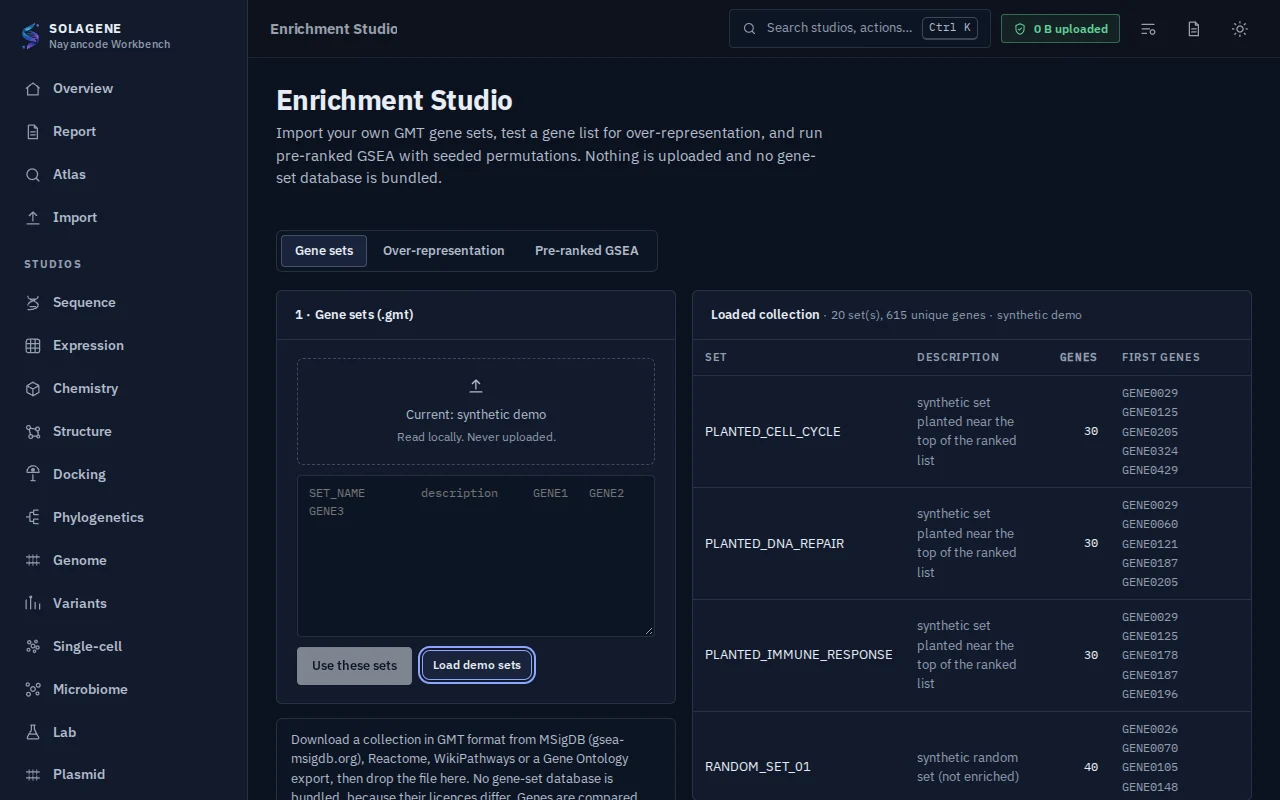
Gene Set Enrichment tests a gene list for over-representation against GMT gene sets you import, using the hypergeometric test in log space and Benjamini–Hochberg correction. The background is your list universe, so the result reflects the experiment rather than a bundled default.
For ranked data, pre-ranked GSEA walks each set across the ranked list and estimates significance from seeded gene-set permutations. Running-sum curves and hit positions are returned for every tested set. No gene-set database is bundled; identifiers must match your files.
Technical specifications
- Inputs
- GMT gene sets (MSigDB, Reactome, WikiPathways, GO exports) · Gene list · Optional background gene list · Ranked gene list (gene + score)
- Outputs
- ORA table with fold enrichment and FDR · GSEA table with NES, p and FDR · Running-sum curves · CSV export
- Engine
- TypeScript kernels; GSEA permutations in a Web Worker
- Platforms
- Chrome, Edge, Firefox and Safari (current versions) · Windows, macOS, Linux and ChromeOS · No installation and no upload; free account for the Workbench
- Limits
- Results depend entirely on the uploaded sets and background; identifiers must match, and the analysis does not establish pathway activity. No gene-set database is bundled
- Licence
- Free plan for study and academic research (free account); Lab, Institution and cloud-compute plans for business
Features
Capabilities
GMT import
Your own gene sets, with duplicate genes removed.
ORA
Hypergeometric p-values, fold enrichment and BH FDR against your background.
Pre-ranked GSEA
Weighted running sum, NES, permutation p and FDR.
Curves
Running-sum curve with hit positions for each tested set.
CSV export
The full result table for reporting or further analysis.
Use cases
Who uses it, and for what
- Testing a differential-expression gene list
- Checking a pathway hypothesis with your own sets
- Running GSEA without uploading expression data
- Teaching the difference between ORA and GSEA
Documentation
Quick start
Open Gene Set Enrichment
Use the button on this page or the Workbench menu. Nothing to install; works in current Chrome, Edge, Firefox and Safari.
Load data or the demo
Drop in your files (GMT gene sets (MSigDB, Reactome, WikiPathways, GO exports), Gene list, Optional background gene list) or load the labelled synthetic demo to explore safely.
Run and inspect
Results appear as interactive figures and tables; each analysis records its parameters and versions.
Export and cite
Export figures and tables, add them to a report, and copy the auto-written methods paragraph.
Learn the methods with Vedicgen
Courses that use Gene Set Enrichment
Talk to us
Request a demo or ask a question
For classroom use, self-hosted deployments, custom apps or support. We reply within two working days.
Free: Free
Lab: From ₹4,999 per month, billed yearly (US$119 outside India)
Institution: Quoted
Cloud compute & analysis: Quoted