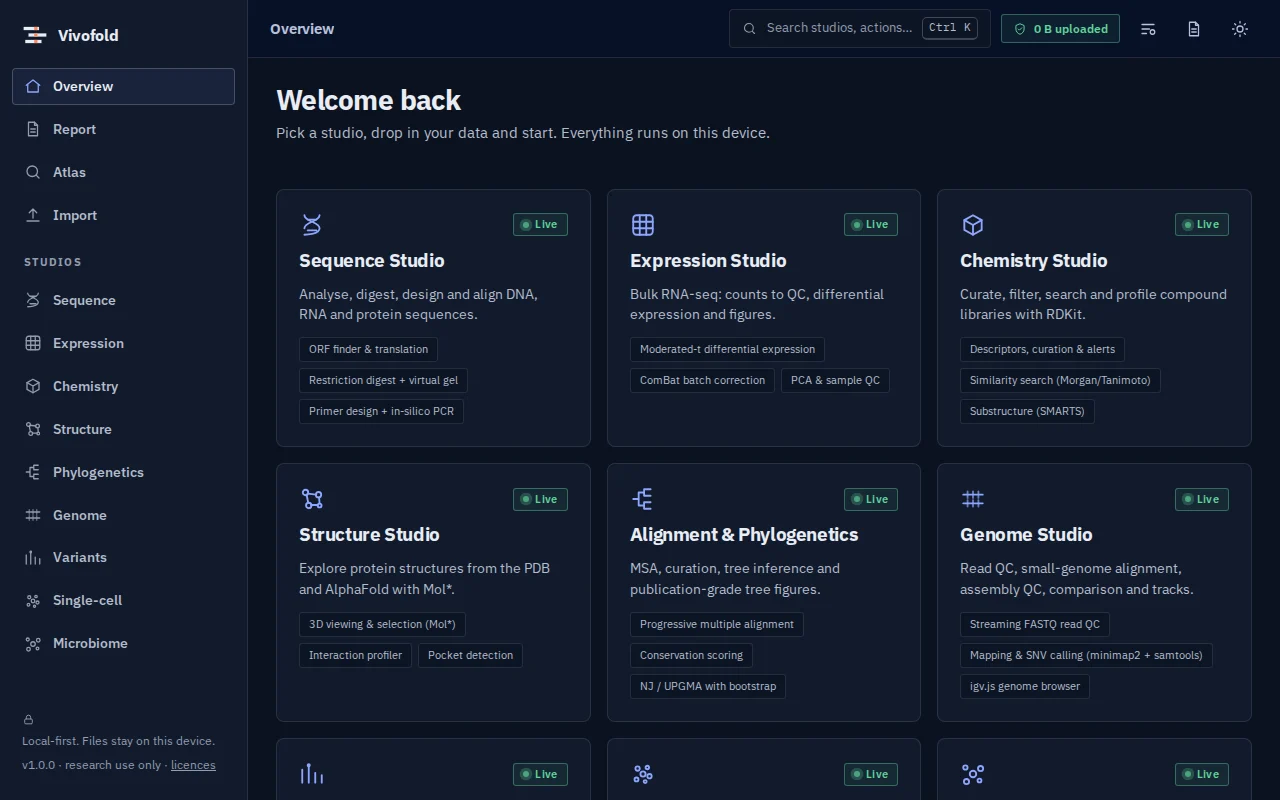
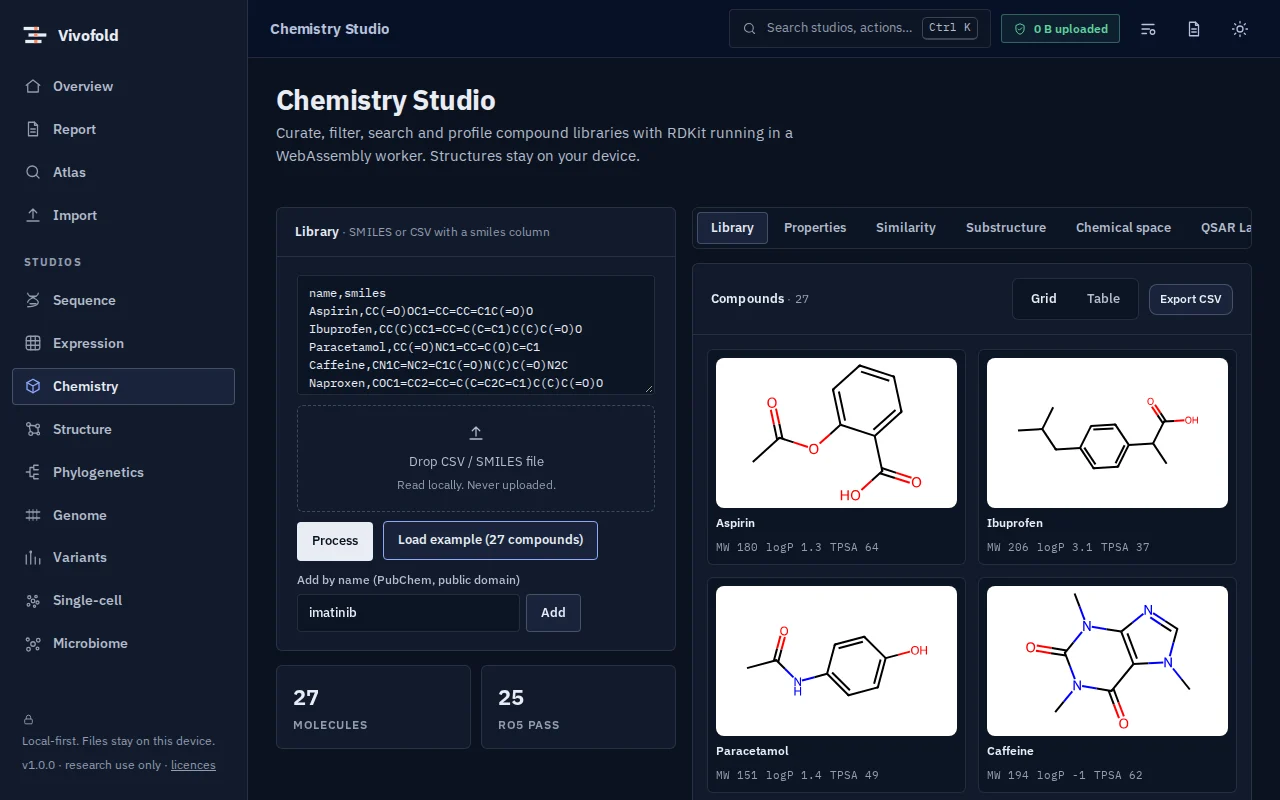
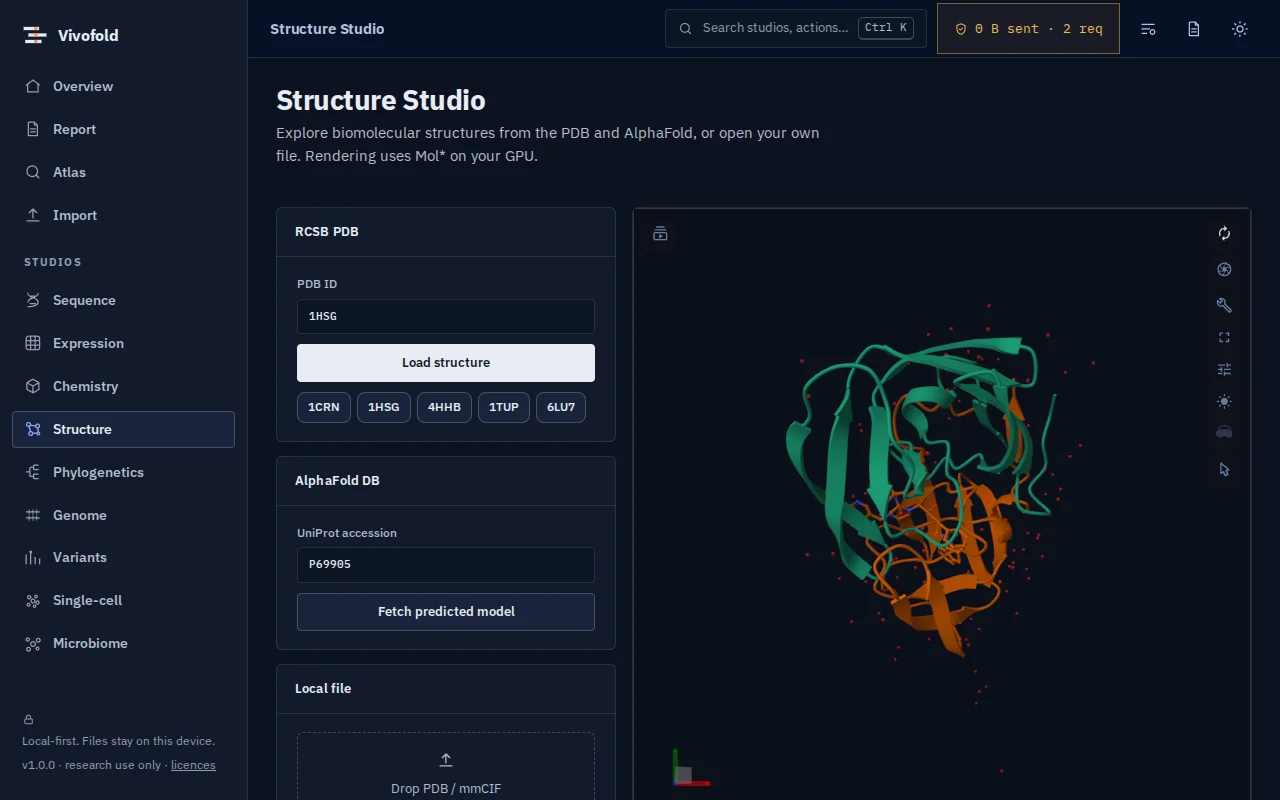
Chemistry & structure
Nayancode Antibody Developability
A sequence-level look at an antibody before you make it.
Antibody developability: Kabat-style CDR identification, sequence liabilities, pI and charge, hydrophobicity and flags for up to twelve chains.
Free · your files are not uploaded
Overview
What Antibody Developability does
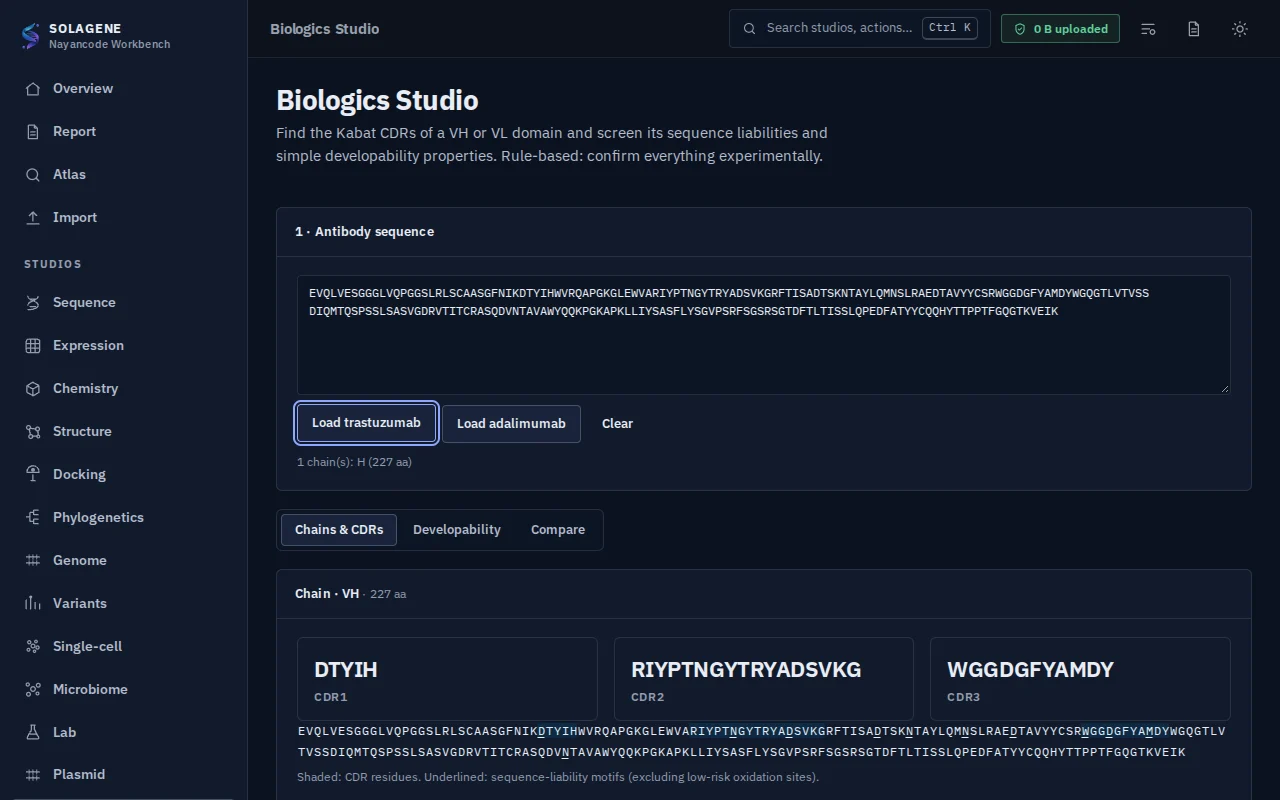
Antibody Developability takes a VH or VL sequence — or an scFv, which it splits into its chains — and reports what a developability review asks for first: the CDRs from the published heuristic Kabat rules, then the sequence liabilities in and around them, such as deamidation, isomerisation, N-glycosylation sequons, oxidation motifs and free cysteines.
It also computes pI, net charge at pH 7.4, GRAVY and CDR composition, and compares up to twelve chains side by side. The CDR logic is checked on trastuzumab and adalimumab, whose CDRs come out exactly as published, with liabilities reported as in-CDR or framework. There is no numbering database and no structure here: the flags are published rules of thumb, and the app labels them as rules of thumb rather than validated cut-offs.
Technical specifications
- Inputs
- VH / VL amino-acid sequence · scFv sequence
- Outputs
- CDR assignments · Liability table with positions · Physicochemical summary · Comparison table and figures
- Engine
- TypeScript
- Platforms
- Chrome, Edge, Firefox and Safari (current versions) · Windows, macOS, Linux and ChromeOS · No installation and no upload; free account for the Workbench
- Limits
- No numbering database, no structure; the flags are published rules of thumb, not validated cut-offs
- Licence
- Free plan for study and academic research (free account); Lab, Institution and cloud-compute plans for business
Features
Capabilities
Heuristic Kabat CDRs
VH and VL CDR-H1 to CDR-L3 by the published pattern rules, with scFv splitting.
Liability scan
Deamidation, isomerisation, glycosylation sequons, oxidation and free cysteine, flagged by region.
Biophysical summary
pI, charge at pH 7.4, GRAVY and CDR composition per chain.
Chain comparison
Up to twelve chains side by side to rank candidates.
Stated interpretation
Every flag is shown as a rule of thumb, never as a pass/fail decision.
Use cases
Who uses it, and for what
- Triaging antibody sequences early in discovery
- Choosing between candidates with the same epitope
- Explaining a liability to a CMC review
- Teaching antibody numbering and CDR structure
Documentation
Quick start
Open Antibody Developability
Use the button on this page or the Workbench menu. Nothing to install; works in current Chrome, Edge, Firefox and Safari.
Load data or the demo
Drop in your files (VH / VL amino-acid sequence, scFv sequence) or load the labelled synthetic demo to explore safely.
Run and inspect
Results appear as interactive figures and tables; each analysis records its parameters and versions.
Export and cite
Export figures and tables, add them to a report, and copy the auto-written methods paragraph.
Learn the methods with Vedicgen
Courses that use Antibody Developability
Talk to us
Request a demo or ask a question
For classroom use, self-hosted deployments, custom apps or support. We reply within two working days.
Free: Free
Lab: From ₹4,999 per month, billed yearly (US$119 outside India)
Institution: Quoted
Cloud compute & analysis: Quoted