Chemistry & structure
Nayancode Peptide Analysis
Mass, charge, helical wheels and fragment ions for a peptide.
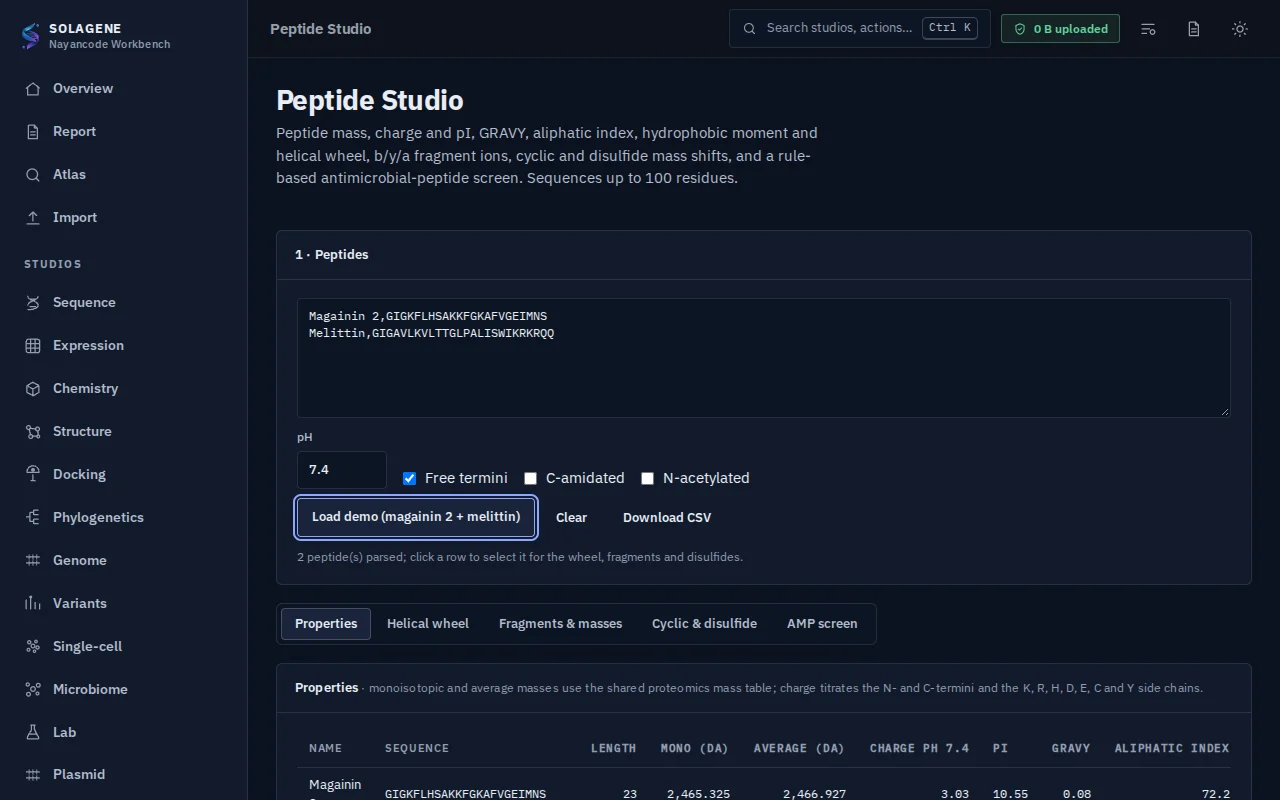
Peptide analysis up to 100 residues: monoisotopic and average mass, charge at a set pH, pI, GRAVY, hydrophobic moment, helical wheel, cyclic forms and an AMP screen.
Free · your files are not uploaded
Overview
What Peptide Analysis does
Peptide Analysis answers the questions that come before synthesis: what the peptide weighs (monoisotopic and average), what net charge it carries at the pH you work at, where its isoelectric point lies, and how hydrophobic it is by GRAVY, aliphatic index and Eisenberg hydrophobic moment, with residue composition alongside.
It goes further than a property table: a helical wheel for amphipathicity, cyclic and disulfide forms with the pairings they imply, b, y and a fragment ions with neutral losses for MS/MS method development, and a heuristic antimicrobial screen from charge and hydrophobicity. Masses and the hydrophobic moment are cross-checked against an independent Python reference. The AMP note appears on the page itself: the screen is a set of simple physicochemical rules, it is not trained or validated against activity data, and antimicrobial activity must be measured.
Technical specifications
- Inputs
- Peptide sequence (1-100 residues) · CSV with sequences · pH for charge calculation
- Outputs
- Property table · Helical-wheel figure · Fragment-ion lists · Cyclic and disulfide masses · AMP score with the criteria shown
- Engine
- TypeScript kernels
- Platforms
- Chrome, Edge, Firefox and Safari (current versions) · Windows, macOS, Linux and ChromeOS · No installation and no upload; free account for the Workbench
- Limits
- Peptides up to 100 residues; longer sequences error out
- Licence
- Free plan for study and academic research (free account); Lab, Institution and cloud-compute plans for business
Features
Capabilities
Mass and formula
Monoisotopic and average mass, linear, cyclic and with disulfide bonds.
Charge and pI
Henderson–Hasselbalch charge at any pH, with blocked termini handled.
Hydrophobicity
GRAVY, aliphatic index and Eisenberg hydrophobic moment.
Helical wheel
Amphipathic helices drawn with residue marks and export.
Fragment ions
b, y and a ions with neutral losses for mass-method set-up.
AMP screen
Heuristic antimicrobial-peptide score from charge, hydrophobicity and cysteines.
Use cases
Who uses it, and for what
- Checking a designed peptide before ordering
- Reading a mass spectrum with real fragment m/z
- Judging whether a helix is amphipathic
- Shortlisting candidate antimicrobial peptides to test
Documentation
Quick start
Open Peptide Analysis
Use the button on this page or the Workbench menu. Nothing to install; works in current Chrome, Edge, Firefox and Safari.
Load data or the demo
Drop in your files (Peptide sequence (1-100 residues), CSV with sequences, pH for charge calculation) or load the labelled synthetic demo to explore safely.
Run and inspect
Results appear as interactive figures and tables; each analysis records its parameters and versions.
Export and cite
Export figures and tables, add them to a report, and copy the auto-written methods paragraph.
Learn the methods with Vedicgen
Courses that use Peptide Analysis
Talk to us
Request a demo or ask a question
For classroom use, self-hosted deployments, custom apps or support. We reply within two working days.
Free: Free
Lab: From ₹4,999 per month, billed yearly (US$119 outside India)
Institution: Quoted
Cloud compute & analysis: Quoted