Genomics & transcriptomics
Nayancode Similarity Search
Smith-Waterman against a whole protein database, on your own GPU.
Exhaustive affine-gap Smith-Waterman protein search with BLOSUM62, bit scores, Karlin-Altschul E-values and traceback on WebGPU or your CPU.
Free · your files are not uploaded
Overview
What Similarity Search does
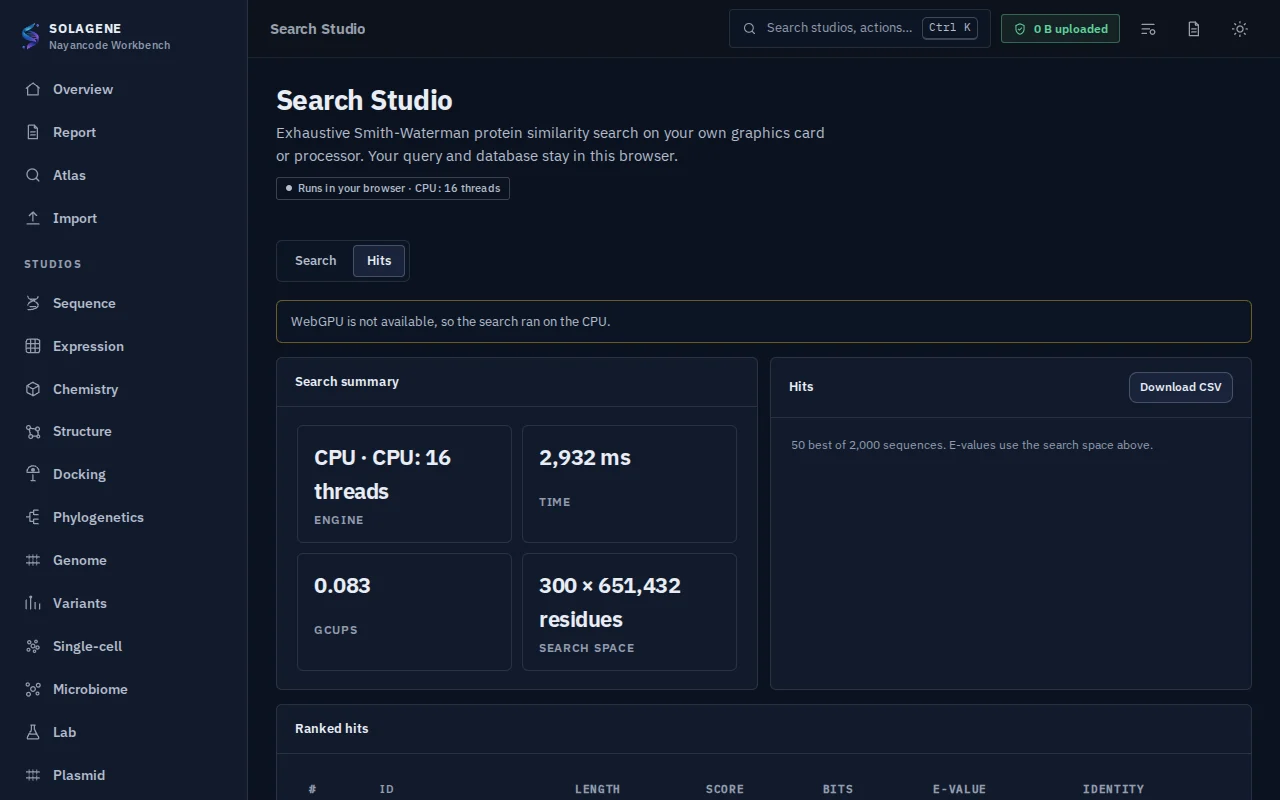
Similarity Search compares one protein query against every sequence in a protein FASTA database using affine-gap Smith-Waterman (Gotoh) with BLOSUM62 and gap costs 11/1. The WebGPU path gives each database sequence its own thread and its own H and E vectors, so the search is exhaustive rather than seeded, and a CPU worker computes the same scores when no GPU is available.
Hits are ranked by score, converted to bit scores and Karlin-Altschul E-values with published parameters, and the top 50 receive a full traceback with identity and alignment coordinates. The bundled 2,000-sequence demo is synthetic and contains five planted members of a known family, so you can see the ranking work before loading your own database.
Technical specifications
- Inputs
- One protein query (one letter code or FASTA) · Protein FASTA database, or the bundled 2,000-sequence SYNTHETIC demo
- Outputs
- Ranked hit table with score and E-value · Bit scores and identity · Traceback alignments for the top 50 · CSV export
- Engine
- TypeScript and WebGPU (f32/integer) kernels; CPU search runs in a Web Worker
- Platforms
- Chrome, Edge, Firefox and Safari (current versions) · Windows, macOS, Linux and ChromeOS · No installation and no upload; free account for the Workbench
- Limits
- Exhaustive search is slower than BLAST on huge databases. E-values use published gapped BLOSUM62 parameters without edge-effect correction. Protein queries only; research-grade, not clinical. Runs in your browser; uses your GPU through WebGPU when available.
- Licence
- Free plan for study and academic research (free account); Lab, Institution and cloud-compute plans for business
Features
Capabilities
Exhaustive GPU search
One GPU thread per database sequence, with a planner sized from your device limits.
CPU fallback
A Web Worker computes the same scores with progress when WebGPU is unavailable.
Affine gaps
Gotoh algorithm with BLOSUM62 and gap open 11, extend 1, stated on the page.
E-values and bit scores
Karlin-Altschul parameters for gapped BLOSUM62, with the edge-effect caveat stated.
Traceback
The top 50 hits include alignment identity and coordinates.
Synthetic demo db
2,000 seeded sequences with five planted family members, plus CSV export.
Use cases
Who uses it, and for what
- Searching a protein family exhaustively
- Comparing exhaustive search with BLAST heuristics
- Benchmarking your GPU on a real alignment workload
- Teaching how E-values and traceback work
Documentation
Quick start
Open Similarity Search
Use the button on this page or the Workbench menu. Nothing to install; works in current Chrome, Edge, Firefox and Safari.
Load data or the demo
Drop in your files (One protein query (one letter code or FASTA), Protein FASTA database, or the bundled 2,000-sequence SYNTHETIC demo) or load the labelled synthetic demo to explore safely.
Run and inspect
Results appear as interactive figures and tables; each analysis records its parameters and versions.
Export and cite
Export figures and tables, add them to a report, and copy the auto-written methods paragraph.
Learn the methods with Vedicgen
Courses that use Similarity Search
Talk to us
Request a demo or ask a question
For classroom use, self-hosted deployments, custom apps or support. We reply within two working days.
Free: Free
Lab: From ₹4,999 per month, billed yearly (US$119 outside India)
Institution: Quoted
Cloud compute & analysis: Quoted